Interaction Designer · 2023
A chatbot built with Aschehoug on their school curriculum, and a linguistic framework for how AI should talk to children who are learning.
Getting a straight answer out of an AI is easy. Getting one a twelve-year-old can learn from is harder. The words a system chooses and the questions it asks back decide whether a child engages with the material or copies the answer and moves on.
Aschehoug publishes the textbooks Norwegian primary school students use every day. The question was what happens when that content becomes the basis for a conversational AI, and how to design a chatbot that helps students understand the material instead of doing the thinking for them.
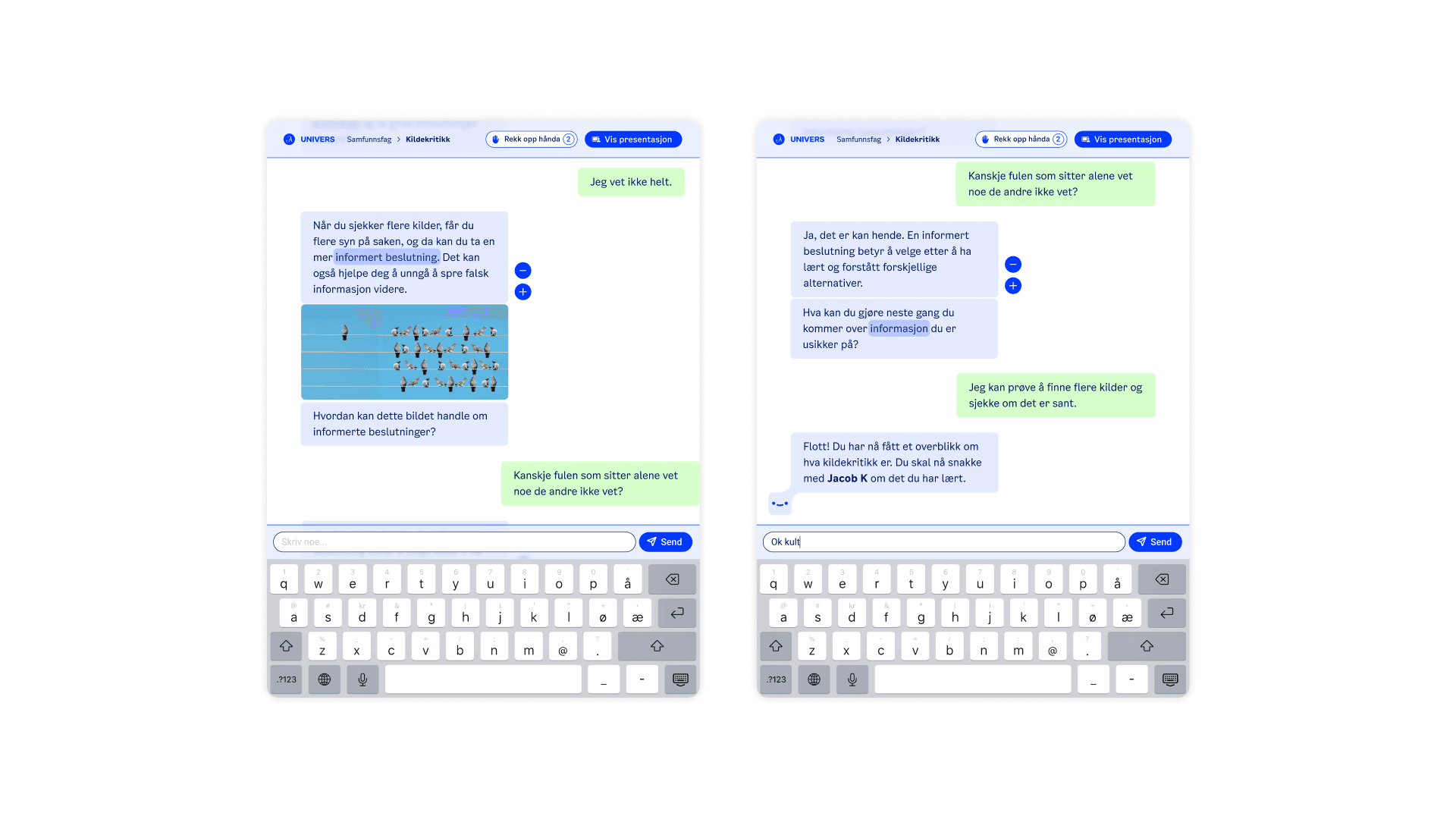
Ask was developed in collaboration with Aschehoug as a concept for 7th graders. The idea is that students use it to work through subject matter before bringing it into classroom discussion, with Ask drawing exclusively from Aschehoug's own textbooks rather than the open web. The name is a play on Aschehoug, the Norwegian name Ask, and the act of asking a question.
The project covered research into AI communication and pedagogy, concept development, interviews with users and experts, testing, visual design and prototyping. It was developed together with Hanne Lockertsen. Besides the service itself, it produced a linguistic framework for how AI should talk to children when they're learning, one that could apply beyond this product.